
Medical disclaimer: I am not a doctor, nurse, or licensed medical professional. This post is for informational purposes only and is based on my personal caregiving experience. Always consult a qualified healthcare provider before making any changes to your loved one's medications.
This post contains affiliate links. If you click a link and make a purchase I may earn a small commission at no extra cost to you. I only recommend products I genuinely believe would help fellow caregivers.
There is a moment most caregivers know well. You are standing in the kitchen at 7am, holding three different pill bottles, trying to remember if your loved one already took their blood pressure medication — or if that was yesterday. The bottles all look the same. The names are impossible to pronounce. And your loved one has no memory of whether they took anything at all.
Managing medications for an elderly loved one is one of the most stressful and high-stakes parts of caregiving. Get it right and you are protecting their health and their life. Get it wrong — either a missed dose or an accidental double dose — and the consequences can be serious.
I know this not just from research but from real daily life. My mother takes multiple medications. My aunt takes even more. Keeping it all straight while managing everything else a full caregiving household demands is genuinely hard work.
Over time I have developed a system that works for us. This post shares everything I have learned — practical, honest, and field-tested in the trenches of real caregiving.
Why medication management is especially challenging for elderly loved ones
Before we get into the tips it helps to understand why this is so uniquely difficult. Elderly loved ones often take many medications — sometimes ten or more — prescribed by different doctors who may not always communicate with each other. Dosing schedules can be complicated. Some medications need to be taken with food. Others cannot be taken together. Some need to be taken at specific times of day for maximum effectiveness.
Add dementia to the picture and the challenge multiplies. A loved one with dementia may not remember whether they took their medication. They may refuse to take it. They may hide pills, spit them out, or insist they have already taken something they have not. None of this is willful. It is the disease. But it makes the caregiver’s job significantly harder.
Here is what has helped us.
10 practical tips for managing medications for your elderly loved one
1. Create a master medication list and keep it updated
Write down every single medication your loved one takes, prescription and over the counter. Include the name, dosage, what it is for, the prescribing doctor, and when it should be taken. Keep one copy in your home and one in your wallet or phone for doctor appointments and emergency room visits. I have an iPhone and the Notes app is very useful in managing information like this. I create the list in excel (any spreadsheet type software will work) and then store it in my Notes app for easy access when needed.
This list has saved us hours of time in doctors’ offices and avoided dangerous errors when new medications were being prescribed.
2. Use a pill organizer — the right kind
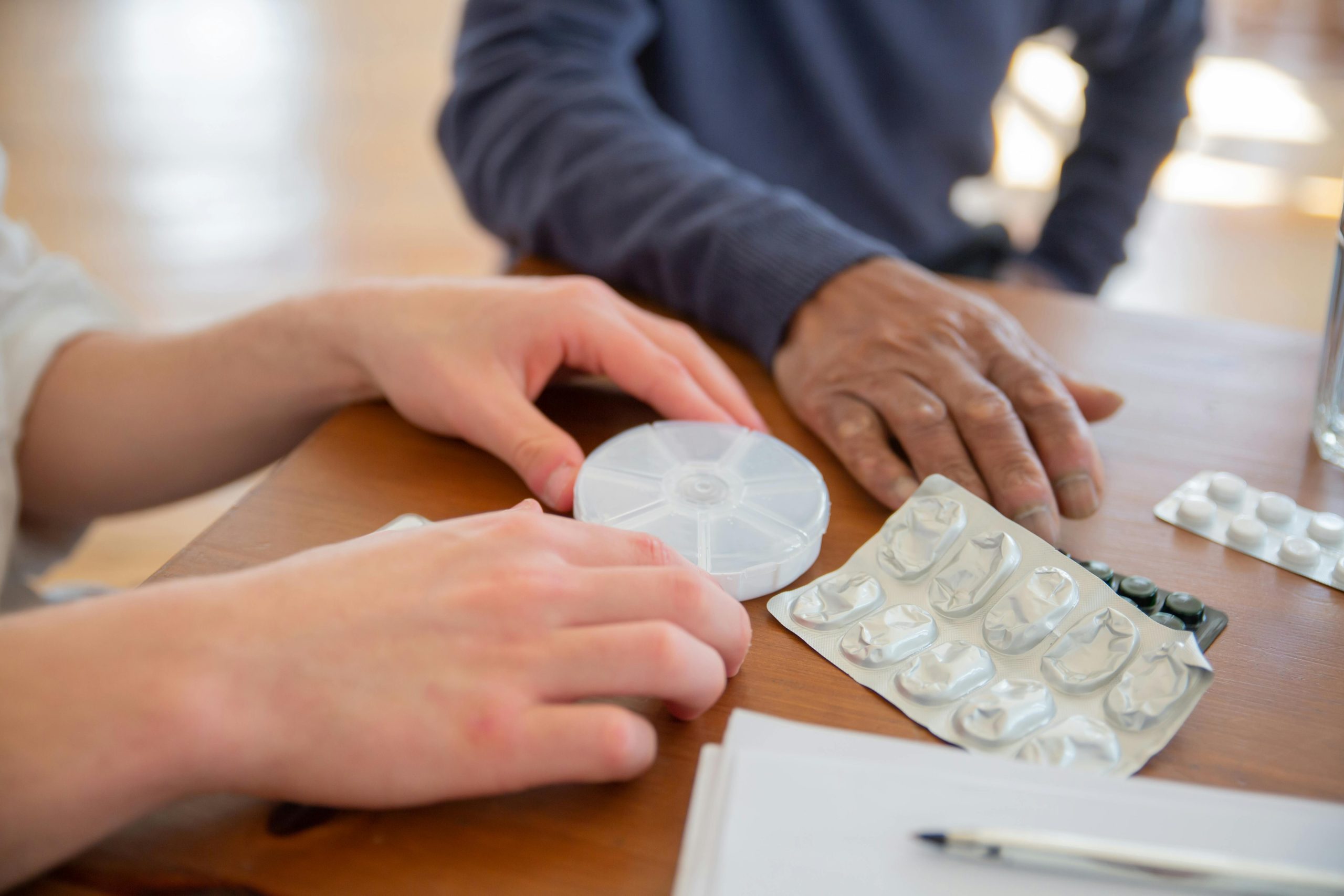
A good weekly pill organizer is one of the simplest and most effective medication management tools available. I know most people use the one with large compartments, easy-to-open lids, and clear labeling for AM and PM doses, but can’t tell you how many times pills have gotten spilled or mixed up with this type. Especially if you are caring for several people, the one I found to be most efficient is one that uses mini ziplock pill bags. Fill it once a week on the same day each week so you always know at a glance whether a dose has been taken.
For loved ones with dementia, keeping medications in a secure area is a good safety measure. Reusable Pill Bag / Disposable Pill Bag/ EZY Dose Pill Sorter
3. Set phone alarms for every dose
Do not rely on memory, yours or theirs. Set a phone alarm for every medication time. Label each alarm clearly, “Mom’s morning medications” or “Aunt’s blood pressure pill.” When the alarm goes off that is your cue to supervise or administer the dose and check it off your list.
I have multiple alarms set throughout the day. On the hard days when I am exhausted and distracted those alarms are the difference between a dose given and a dose missed.
4. Keep a medication log
A simple notebook can work perfectly for this but since I came from the business world I create forms for everything to make my life easier. Every time a medication is given write down the date, time, and what was given. If a dose is missed or refused write that down too. This log becomes invaluable at doctor appointments, during hospital visits, and if you ever need to hand care over to someone else temporarily.
It also gives you peace of mind on the days when you genuinely cannot remember, you do not have to rely on memory when you have a record.
5. Talk to a pharmacist; they are an underused resource
Your pharmacist knows your loved one’s medications as well as any doctor and sometimes better. They can review all the medications for dangerous interactions, help you understand what each one does, explain the best time of day to take each one, and suggest ways to make medications easier to swallow or tolerate.
Most pharmacies offer free medication reviews. Call yours and ask for one. It takes less than 30 minutes and could catch something important that has been overlooked.
6. Request a medication review from the doctor
Ask your loved one’s primary care doctor for a full medication review at least once a year or whenever a new medication is added. This is extremely important if your loved one has multiple doctors or specialists they use. Polypharmacy (the use of multiple medications simultaneously) is a serious concern for elderly patients and can cause falls, confusion, fatigue, and other problems.
Do not be afraid to ask: “Does my mother really need all of these medications? Are any of them interacting with each other?” You are your loved one’s greatest advocate. It is your job to ask so don’t be intimidated or hurried by the physician.
7. Know what each medication is for
You do not need a medical degree but you do need to know the basics. What is each medication treating? What are the most common side effects? What are the warning signs that something is wrong? Understanding the purpose of each medication helps you notice if something is not working or if a side effect is being missed. I have found it very helpful to put a label on the bottle lids or write with a sharpie the names of the medications. This is a time saver when you are filling weekly medications bags.
Write a plain-English description next to each medication on your master list. “This one is for blood pressure. This one is for thyroid. This one helps with sleep.” Simple but powerful.
8. Handle medication refusal with patience not force
If your loved one, especially one with dementia, refuses medication do not force it. Forced medication is distressing for everyone and can damage trust. Instead try offering it with a favorite food or drink, changing the time of day, crushing it if the doctor says that is safe, or simply waiting and trying again in 20 minutes.
Sometimes my mother refuses her morning medications and I simply say “Okay, let’s try again after breakfast.” Nine times out of ten she takes them without issue 30 minutes later when she is less agitated. Pick your moment.
9. Store medications safely and correctly
Most medications should be stored in a cool dry place away from heat and humidity, which means the bathroom medicine cabinet is actually not ideal. Keep them in a kitchen cupboard away from the stove, or a bedroom dresser. For loved ones with dementia lock medications away entirely — both to prevent them from taking the wrong dose and to prevent them from refusing or hiding medications.
A simple lockable box or cabinet works well. It removes the medication from sight and reduces the likelihood of confusion or accidental overdose.
10. Have an emergency plan for missed doses
Know in advance what to do if a dose is missed for each medication. Some missed doses are fine to take when remembered. Others should be skipped entirely if it is too close to the next scheduled dose. Ask your pharmacist or doctor for the specific guidance for each medication on your list and write it down.
Never double dose to make up for a missed one unless your doctor has specifically told you to do so for that particular medication. When in doubt call the pharmacist first they can usually tell you in under two minutes.
One more thing worth saying: If medication management has become genuinely overwhelming; if the complexity has grown beyond what you can safely manage alone, please ask for help. Talk to your loved one’s doctor. Ask about home health aides who can assist with medication administration. Look into automatic medication dispensers. You do not have to manage this entirely on your own.
Tools that have helped us
Over the years I have found a few tools that make medication management significantly easier. Here are the ones I genuinely recommend:
- A weekly AM/PM pill organizer Reusable Pill Bag / Disposable Pill Bag / EZY Dose Pill Sorter
- A lockable medication storage box Lockable Medication Box
- A dedicated notebook for your medication log, keep it in the kitchen or where ever you administer medications or a tablet like the Remarkable Tablet
Medication management quick checklist
- Master medication list created and up to date
- Weekly pill organizer filled and labeled
- Phone alarms set for every dose time
- Medication log started and kept current
- Pharmacist medication review completed
- Doctor medication review requested
- Plain-English description written for each medication
- Medications stored safely and out of reach if needed
- Missed dose plan noted for each medication
- Emergency contact numbers posted near medications
“Let all that you do be done in love.” 1 Corinthians 16:14
That is what medication management is at its core, love made practical. It is not glamorous. It is not the part of caregiving anyone talks about at church or posts about on social media. But it is one of the most faithful, devoted things you can do for someone you love.
Every alarm you set. Every pill you sort. Every log entry you write. It all says the same thing: I see you. I am paying attention. You matter enough for me to get this right.
That is love in action. And it counts.
What is your biggest challenge with medication management? Is there a system or tool that has helped you that I have not mentioned?
Leave a comment below. I do my best to read every single one, and your experience might help another caregiver who is struggling with the same thing.
With love and faith,
Amy
Called to Caregiving
A Free Gift for Tired Caregivers
Get my free Caregiver Emergency Information Sheet, the one page that speaks for your loved one when you cannot. Print it, keep it by the door, and take one thing off your plate.
Send me the free sheet