Medical disclaimer: I am not a doctor or licensed mental health professional. This post is for informational and encouragement purposes only and is based on my personal caregiving experience. If you are experiencing serious symptoms of depression, anxiety, or burnout please consult a qualified healthcare provider.
This post contains affiliate links. If you click a link and make a purchase I may earn a small commission at no extra cost to you. I only recommend products I genuinely believe would help fellow caregivers.
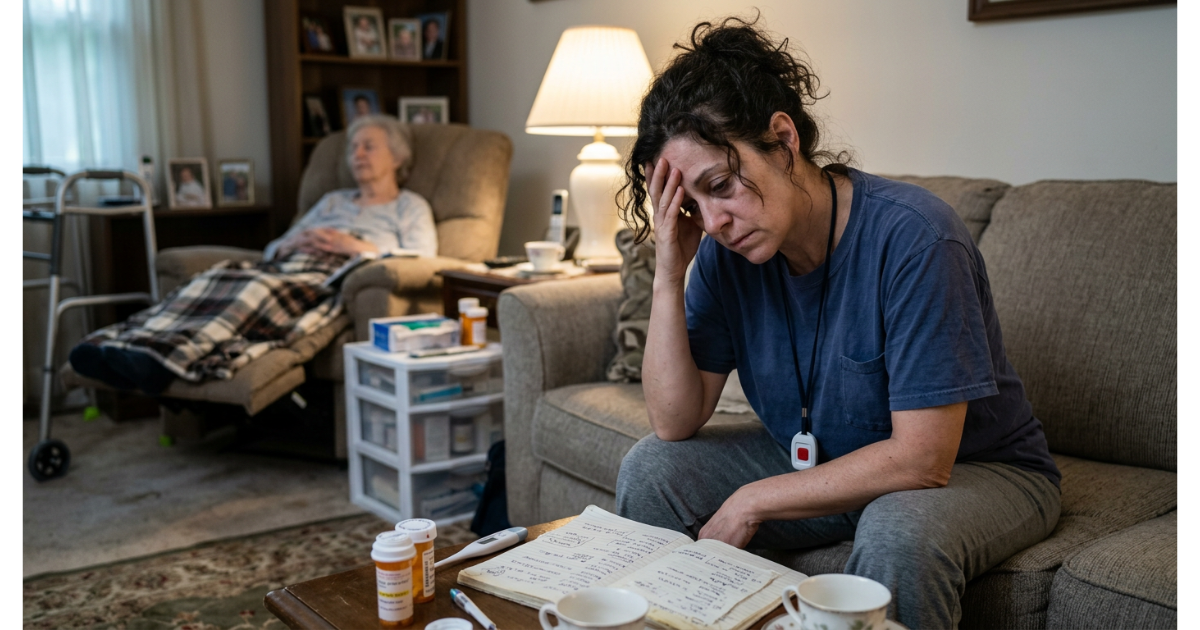
I did not realize I was burning out until I was already there. It did not announce itself. It crept in slowly — disguised as a bad week, a rough month, a season that just felt harder than usual. By the time I recognized what was happening I was running on empty and had been for a long time.
Nobody tells you that caregiver burnout does not feel like collapsing. It feels like going numb. It feels like getting through the day on autopilot. It feels like losing interest in things you used to love and not quite being able to remember who you were before caregiving consumed everything.
If any of that sounds familiar — this post is for you.
Caregiver burnout is real, it is common, and it is one of the most underdiscussed crises in family caregiving. Studies suggest that somewhere between 40 and 70 percent of family caregivers show clinically significant symptoms of depression. Those numbers are not surprising to anyone who has lived this life. What is surprising is how rarely we talk about it honestly.
So let us talk about it.
What caregiver burnout actually is
Burnout is not just tiredness. Everyone who cares for another person gets tired. Burnout is what happens when the physical, emotional, and spiritual demands of caregiving consistently exceed your ability to recover from them over a long period of time.
It is the difference between running low on fuel and running the engine completely bone dry. One you can recover from with rest. The other requires something more deliberate.
The tricky part is that caregivers are often the last people to recognize burnout in themselves — because caregiving demands that you keep going regardless of how you feel. You develop a remarkable capacity to push through. That capacity becomes both your greatest strength and the thing that allows burnout to go undetected for far too long.
10 warning signs of caregiver burnout
1. You feel exhausted no matter how much you sleep
This is not ordinary tiredness. This is bone-deep fatigue that does not lift even after a full night’s rest. You wake up already depleted. The tank never feels full anymore — usually because you never get into a deep sleep cycle. You always have one ear open.
What it feels like: You sleep seven hours and wake up feeling like you have not slept at all. Rest no longer restores you the way it used to.
2. You have stopped doing things that used to bring you joy
Hobbies, friendships, activities that once recharged you — you either do not have time for them anymore or you do not have the desire. The things that used to make you feel like yourself have quietly disappeared from your life.
What it feels like: Someone invites you to something you would have loved before caregiving and you feel nothing. You just don’t have the capacity to get up and go even if you really want to.
3. You feel resentful — and then guilty for feeling resentful
Resentment is one of the most common and least talked about emotions in caregiving. It does not mean you do not love your person. It means you are human and you are exhausted. But the guilt that follows the resentment can be crushing.
What it feels like: You feel a flash of anger when your loved one needs something in the middle of the night — and then immediately feel terrible for feeling it.
4. You are increasingly irritable or short-tempered
Small things that would not normally bother you set you off. You snap at people you love. Your patience — which used to be considerable — has worn dangerously thin and you are not sure how to get it back.
What it feels like: When you answer the same question over and over but on the tenth time you can’t muster a pleasant response — and then feel guilty.
5. You have started to feel like nothing you do is enough
A pervasive sense of inadequacy settles in. No matter how much you do you feel like you are falling short. The standard you hold yourself to keeps rising even as your capacity keeps shrinking.
What it feels like: When you ask your person to get up and walk or when it is time to get a shower and they grumble or completely refuse — and you just let it slide because you are exhausted. You feel like you are letting them down.
6. You have withdrawn from friends and family
Isolation is both a symptom and a cause of burnout. You stop reaching out because you are too tired to explain. You turn down invitations because the effort feels impossible. Slowly the connections that used to sustain you fade into the background.
What it feels like: You get invited somewhere and immediately feel overwhelmed — because it is not a matter of just getting yourself ready to go. You have to figure out everything for your loved one to be taken care of while you are gone.
7. Your physical health is suffering
Burnout shows up in the body. It might show up slowly — but you will notice more frequent illness, a longer time to recover from a simple cold, maybe your own conditions flaring because you are not eating or exercising the way you should. Neglecting your own medical appointments is also a culprit — there is simply no time or energy left for yourself.
Research consistently shows that caregivers have higher rates of high blood pressure, immune dysfunction, and chronic illness than non-caregivers. Your body keeps score even when you are too busy to notice.
8. You have started to feel detached from your loved one
This one is hard to admit. The emotional connection you once felt starts to feel distant. You go through the motions of care without feeling present in them. This is not a character flaw — it is a sign that you have given everything you had and there is nothing left to give from.
What it feels like: You feel like you are just going through the motions and are not appreciated.
9. You have lost your sense of identity outside of caregiving
You cannot remember who you were before this became your whole life. Your needs, your dreams, your preferences — they feel like they belong to someone else. You exist entirely in relation to the person you care for.
What it feels like: When you have given up your job willingly to care for your parent or loved one — but you lose yourself because you no longer have time to do the activities that build you up mentally, emotionally, or physically.
10. Your faith feels distant or flat
Prayer feels hollow. Scripture that used to comfort you now lands without resonance. You go through the motions of faith but the warmth is gone. This spiritual dryness is one of burnout’s quietest and most painful symptoms.
This does not mean God has moved. It means you are exhausted. He is still there — in the same place He always was. But burnout makes it very hard to feel Him. And when you reach a point where it is difficult to get your loved one out to church, that disconnection from your faith community makes everything lonelier still.
If you recognized yourself in several of these signs — please do not add guilt to your already full plate. Recognizing burnout is not failure. It is the first and most important step toward getting better.
What to do when you recognize burnout
Tell someone the truth
Not the polished version. The real version. A trusted friend, a pastor, a counselor, your doctor. Say out loud — “I am not okay.” Those four words are harder to say than they should be for most caregivers. Say them anyway. Help cannot come to a need that has not been named. You are not admitting defeat — far from it. You are admitting that you have been giving everything you have and your tank is running on empty. Give yourself permission to say so. Give yourself permission to ask for help.
Ask for respite — even small amounts
Respite does not have to mean a week away. It can be two hours while a neighbor sits with your loved one. An afternoon while a sibling covers. A morning while your spouse takes over. Small, consistent breaks matter enormously. They are not a luxury — they are a medical necessity for a sustainable caregiving season.
See your own doctor
Caregivers routinely skip their own medical care. If your physical health is suffering — make the appointment. You cannot pour from an empty cup and you cannot care for someone else from a hospital bed.
Consider counseling
Therapy is not a sign of weakness. It is a tool — and one that is specifically useful for processing the complicated grief, resentment, and loss that come with caregiving. Many therapists specialize in caregiver support. Your mental health matters as much as your loved one’s physical health.
One thing that helped me in my own burnout season was keeping a devotional close. Comfort for Caregivers is written specifically for people in this role — 100 short readings by caregivers who understand what you are carrying. Some days you just need someone to say “me too” in two pages or less.
Reduce where you can
Look honestly at everything on your plate. Not the caregiving — but everything else. What can be simplified, delegated, or let go of entirely for this season? You do not have to do everything. You just have to do the most important things.
If you are looking for a way to bring your honest prayers to God without knowing where to start, this Prayer Journal for Women has a simple structure that helps. Scripture, a prompt, space to write the thing you cannot say out loud. That is enough.
“He gives strength to the weary and increases the power of the weak. Even youths grow tired and weary, and young men stumble and fall; but those who hope in the Lord will renew their strength.” Isaiah 40:29–31
When to seek immediate help: If you are experiencing thoughts of harming yourself or your loved one, if you are unable to function in daily life, or if you feel completely unable to cope — please reach out to a healthcare provider or crisis line immediately. The 988 Suicide and Crisis Lifeline is available 24 hours a day by calling or texting 988.
Burnout does not make you a bad caregiver. It makes you a human one. The very fact that you burned out is evidence of how much you have given — how fully and faithfully you have shown up for someone you love.
But you were not made to be consumed by this. You were called to it — and there is a difference. A calling sustains. A calling has grace built into it. A calling does not require you to destroy yourself in service to it.
Take care of yourself, friend. The person you care for needs you — but so do you.
Have you experienced caregiver burnout? Are you in the middle of it right now?
Leave a comment below. You do not have to carry this quietly. This community is here — and so am I.
With love and faith,
Amy
Called to Caregiving
A Free Gift for Tired Caregivers
Get my free Caregiver Emergency Information Sheet, the one page that speaks for your loved one when you cannot. Print it, keep it by the door, and take one thing off your plate.
Send me the free sheet